The Job Hugger Epidemic
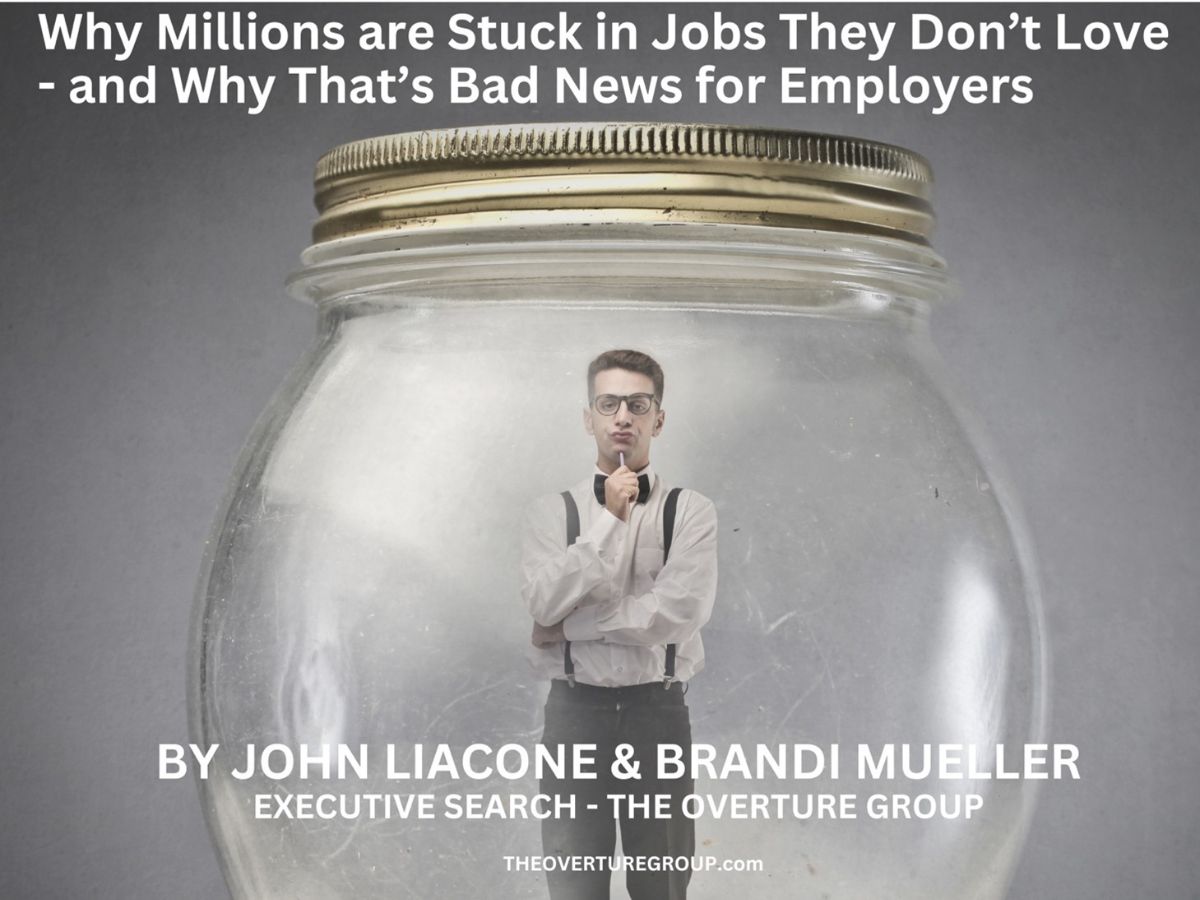
There's a silent crisis unfolding in workplaces across America. Millions of employees are showing up every day to jobs that no longer inspire them, working for companies they feel disconnected from, yet they're not going anywhere. Some call them "job huggers"—workers clinging to their positions not out of passion, but out of fear. As with all human relationships, this is not a good equation.
The data reveals a workforce that's simultaneously disengaged and paralyzed, creating a toxic combination that's costing the economy trillions while leaving individuals feeling trapped and unfulfilled. This equation is also crippling companies that have less and less success attracting highly-qualified candidates, while at the same time operating with current employees who feel trapped and disengaged.
In our experience at The Overture Group over the past six months, the number of passive candidates who say “they are not looking to move at this time” is sharply up. They give various reasons - they “are happy where they are” or “are unwilling to make a move now.” Many also give location or salary as reasons to stay put. In fact, more candidates are asking for job descriptions or salary ranges up front before considering a phone call. At the same time, the percentage of passive candidates who say that they are even willing to discuss a new opportunity is sharply down.
The Engagement Crisis Nobody's Talking About
So what’s going on? Let's start with some sobering statistics. U.S. employee engagement fell to just 31% in 2024, the lowest level in a decade.1 That means roughly 69% of the American workforce is either not engaged or actively disengaged from their work. Data for 2025 is still being assessed, but the trend does not bode well for 2026. Companies seeking highly qualified employees will need to dig deep.
The numbers are even more troubling when broken down further. About 17% of employees are "actively disengaged," meaning they're not just checked out—they're actively undermining their organization's progress out of resentment. 1 Another 62% are "not engaged," unattached to their jobs and company, going through the motions day after day.1
Think about that for a moment. In most workplaces, only three out of ten people actually care about what they're doing. Let that sink in.
The Trillion-Dollar Problem
This disengagement isn't just an emotional issue—it's an economic catastrophe. Disengaged employees cost the global economy $8.8 trillion in lost productivity.2 In the U.S. alone, that figure stands at approximately $1.9 trillion annually.3
For the median S&P 500 company, disengagement costs $282 million every year.2 That's money lost—not just in reduced output but also in mistakes, missed opportunities, poor customer service, and the ripple effects of a workforce that simply doesn't care.
So Why Don't They Just Leave?
Here's where the story gets even more interesting. Despite record levels of dissatisfaction, we're not seeing people quit. In fact, we're experiencing what experts call "The Great Stay"—a complete reversal of the Great Resignation that dominated headlines just a few years ago.
Four out of five employees didn't plan on changing jobs in 2025. The average length of time workers stayed in their previous jobs was 1.6 years, but when asked how long they plan to stay in their current roles, that number jumps to 2.4 years.2 People are hunkering down, and they're doing it out of fear.
The Fear Keeping Everyone Stuck
The anxiety is palpable and widespread. A staggering 81% of workers feared job loss in 2025, with only 4% reporting no concerns whatsoever.5 More than half of full-time workers have increased concerns about their job security, with higher earners feeling even more vulnerable. Among those making between $125,000 and $150,000, 75% are concerned about their job security.6
But it's not just about losing their current job—it's about what comes next. Economic anxieties are keeping people paralyzed. Forty-two percent of full-time workers don't have enough savings to support themselves until they find a new job. Nearly 39% aren't confident in their ability to secure new employment within three months. And 57% expected finding a new job in 2025 would be as difficult or harder than in 2024.5
No one—Employers or Employees—should operate based on Fear. Open communication and mutual understanding create long-term success for everyone. That’s why we guide our Clients & Candidates through the first six months of working together. Onboarding is more than the first week – and we focus on supporting both our Clients and Candidates every step of the way.
The Comfort of the Devil You Know
Despite their dissatisfaction, many employees are staying for reasons that make sense on paper, even if they don't satisfy the soul. The most common reasons include finding their work interesting (41%), financial stability (38%), and liking their management (30%).2
For many, flexibility has become the golden handcuffs. Forty-four percent say their current job offers a level of flexibility they aren't willing to lose.7 After years of remote and hybrid work becoming normalized, the thought of returning to a rigid 9-to-5 office schedule is enough to keep people from exploring new opportunities.
The Generational Divide
Interestingly, younger workers are experiencing even steeper declines in engagement. Workers younger than 35 were five percent less engaged in 2024 compared to the year prior.4 This is particularly concerning given that these employees should theoretically be in their careers' most energetic, ambitious phase. Gen Z and younger millennials are entering a job market that feels increasingly uncertain, where the promise of career growth and meaningful work seems more distant than ever.
What's Missing at Work
Perhaps most troubling is what employees say they lack. Only 46% of employees clearly know what is expected of them at work, down from 56% in 2020. Just 39% feel someone at work cares about them as people, and only 30% strongly agree that someone encourages their development.1 These aren't unreasonable expectations—they're basic Human needs in a workplace. Yet more than half the workforce feels invisible, directionless, and unsupported.
The AI Anxiety Factor
As if all of this wasn’t enough, the looming shadow of artificial intelligence is adding to the fear. More than half of workers anticipate that AI will impact their job security within the next five years, with sectors like software, finance, and HR expressing the highest levels of concern.6 The technology that promises to make work more efficient also creates existential dread about whether there will be work. Combined with recent global economic trends—which concern nearly 74% of respondents6—it's no wonder people are clinging to what they have rather than risking the unknown.
The Cost of Playing It Safe
The tragedy of the “job-hugger” phenomenon is that it creates a self-reinforcing cycle. Disengaged employees produce worse results, which hurts company performance, increases job insecurity, makes people even more afraid to leave, and deepens their disengagement…
Companies are paying billions for physically present but mentally checked-out workforces. Employees are sacrificing years of their lives in roles that drain rather than energize them, and the economy suffers from the massive productivity losses this creates.
Breaking Free
So what's the solution? There's no easy answer, but awareness is the first step. Companies should understand that they can do more to increase employee engagement – creating a magnetic Culture that attracts and retains their workforce – while increasing productivity and profits.
Candidates should know that you're not alone if you recognize yourself in these statistics—showing up but not engaged, wanting to leave but too afraid to take the leap. You're part of a massive, silent majority. The question isn't whether staying in an unfulfilling job has risks. It does—to your mental health, career growth, and long-term earning potential. The real question is whether those risks are greater than the risks of making a change.
For some, the answer may be to stand firm and find ways to reconnect with their work—or their employees—to have honest two-way conversations and carve out meaning in unexpected places. For others, it may be time to begin that job search, update that resume, and take the leap.
As with all resources, the Human workforce evolves and changes year to year based on various factors. What's clear is that the current situation—millions of workers trapped between dissatisfaction and fear—isn't sustainable. That doesn’t work for Employers or Employees. Something has to give. The only question is whether we'll take control of that change or wait for it to be forced upon us.
The Overture Group thrives on helping our Clients & Candidates stay one step ahead of the evolving Executive Search & Compensation landscape. If you’re a Company or a Candidate looking to move to the next level, please consider us a resource. We’re happy to talk.
Please feel free to reach out directly to John Liacone JLiacone@TheOvertureGroup.com or Brandi Mueller BMueller@TheOvertureGroup.com with any questions or comments.

